
Hong Kong linerless label and printing solution
Linerless Label Printing Solution
Linerless labels are adhesive labels produced without traditional release liner. They are suitable for workflows that need on-demand printing, immediate application and reduced backing-paper waste. Easy Scan helps Hong Kong businesses assess linerless printers, label consumables, software output, installation, training, maintenance support and ESG waste-reduction use cases.
Start from the basics
What is a linerless label?
A traditional adhesive label normally includes a backing liner, which becomes waste after the label is applied. A linerless label uses roll material that can be printed and applied without traditional release liner, helping businesses reduce waste handling, simplify frontline work and print labels with more flexible lengths.
Linerless labelling is not only a consumable change. It is a workflow involving label material, printer structure, cutting or tear-off method, label format, barcode readability and onsite operation. Before adoption, businesses should test with real goods, packaging, system output and frontline processes.
- Suitable for on-demand printing and immediate labelling
- Helps reduce liner waste and cleanup work
- Flexible label length for variable content
- Requires suitable printer, consumables and workflow testing

Structure principle
How can a linerless label roll, print and apply without backing paper?
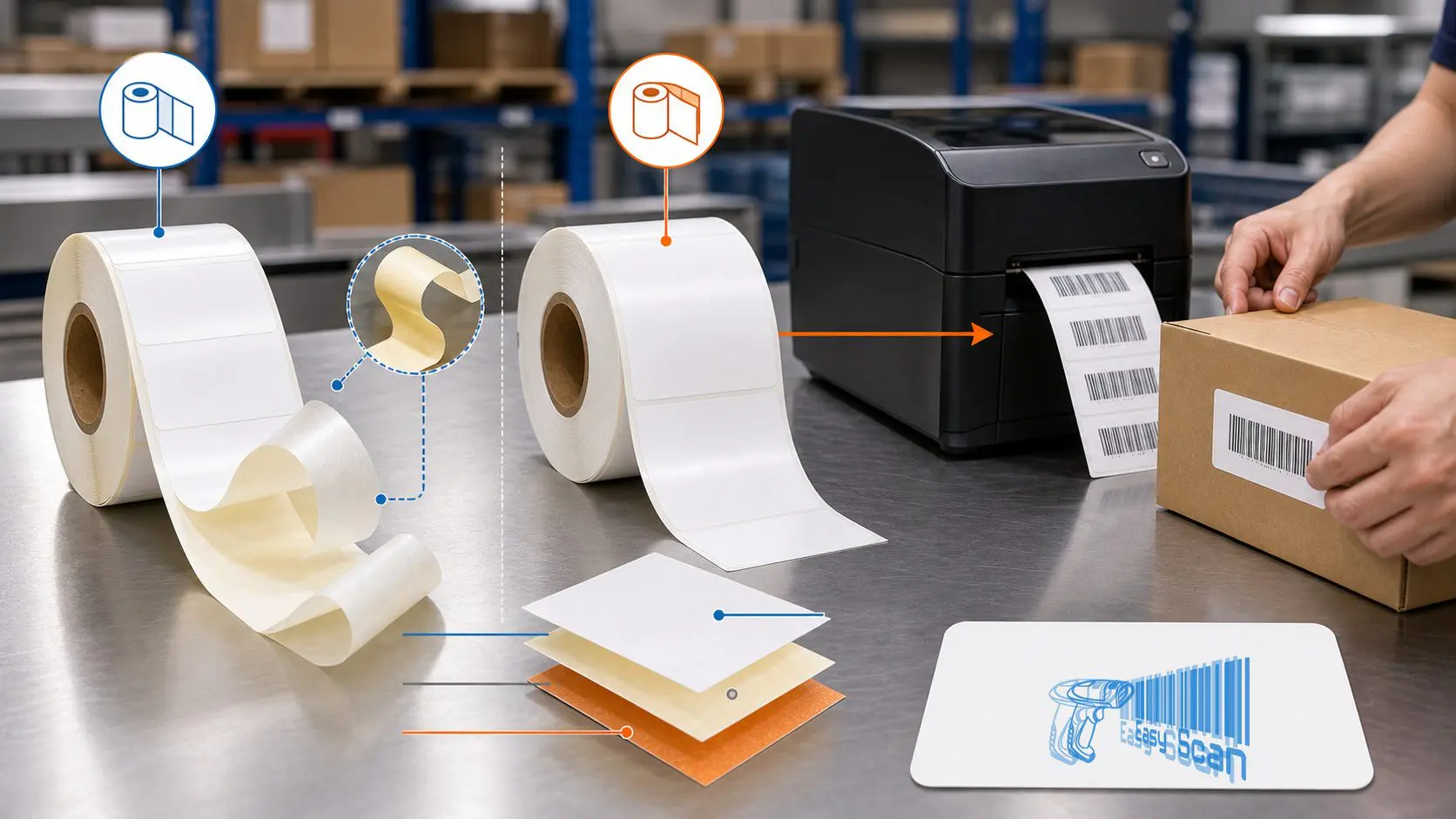
The core principle is the combination of a printable face, release coating and adhesive layer in one roll material. When the material is wound into a roll, the adhesive underside touches the release-coated surface of the next layer. The release coating lets the label separate cleanly instead of sticking permanently to the layer below.
During printing, the material passes through the printer path and the printhead prints text, barcodes, addresses, order data or food information on the face stock. After printing, the label can be torn or cut depending on the equipment design, then applied directly to cartons, bags, packaging, documents or product surfaces. This removes the traditional liner-peeling step and reduces liner waste handling.
Three key layers
- Printable face: carries barcodes, text, icons and scan data
- Release coating: allows the roll layers to separate cleanly
- Adhesive layer: applies the label to the target surface
- Printer path: must match material thickness, adhesive behaviour and tear-off method
Production adoption scenarios
Plan linerless labels around real workflow and label content first
Adopting linerless labels is not just replacing one roll of consumables. A practical deployment should review how labels are printed, applied, scanned and maintained onsite. Label content, printer media path, adhesive performance, application surface, frontline operation and software output should be assessed together to avoid issues such as labels being too long, poor adhesion, low barcode readability or higher cleaning workload after launch.

Step 01
Confirm suitable industries and use cases
Best-fit scenarios include high-volume or on-demand labelling, such as warehouse sorting, logistics dispatch, retail price labels, food packaging, takeaway pickup labels and temporary identification labels.

Step 02
Test printer setup and material behaviour
Use real label sizes, print darkness, tear-off or cutting methods to check barcode clarity, adhesion, release coating behaviour and cleaning or maintenance requirements.

Step 03
Run a pilot before full rollout
Start with selected workstations or stores, collect feedback on frontline handling, scanning performance, consumable usage and maintenance, then decide whether to expand the setup.
Key benefits
Main advantages of linerless labels

Less backing-liner waste
Removing the traditional liner helps reduce waste handling, especially in high-volume retail, logistics and food-packaging workflows.

Better frontline efficiency
Staff can print, tear and apply labels with fewer disposal steps, improving checkout, packing, sorting and service-counter workflows.

More flexible label content
Suitable linerless setups can support variable content such as addresses, order data, food information, promotion messages and operational labels.
Industries and use cases
Suitable industries and applications
Linerless labels are relevant where label usage is high, application is frequent, label content changes often, or backing-paper waste reduction is a practical goal. Final suitability should still be confirmed by printer, consumable, surface and workflow testing.

Warehousing and logistics
Picking labels, shipping labels, carton labels, sorting labels and temporary delivery identification for fast print-and-apply workflows.

Retail, food and F&B
Price labels, promotion labels, food packaging labels, takeaway labels, pickup labels and other on-demand store operation labels.

Operations, service and back office
Temporary identification, document labels, service-process labels and internal transfer labels. Special materials or regulated uses should be checked first.
Comparison table
Linerless labels vs traditional labels
| Item | Linerless labels | Traditional labels with liner | Selection guidance |
|---|---|---|---|
| Liner handling | No traditional release liner, reducing liner waste and cleanup work. | Backing liner remains after application and needs disposal. | Consider linerless where print volume is high and waste reduction matters. |
| Label length | Some setups support variable label length based on content. | Often used in fixed die-cut label sizes. | Linerless can help when label content length changes frequently. |
| Use cases | On-demand packing, logistics, food, retail and temporary operation labels. | Product labels, asset labels, long-term identification and special material labels. | A hybrid setup is often practical instead of replacing all labels. |
| Equipment | Printer, media path, cutter or tear-off method must be compatible. | More common equipment and consumable options are available. | Test linerless labels with the actual workflow before rollout. |
| Maintenance | Adhesive and material behaviour may require regular cleaning and training. | Follows normal barcode printer maintenance practices. | High-volume use should include training, cleaning and service planning. |
Solutions we can provide
How Easy Scan can support a linerless label rollout
Easy Scan helps customers start from the business application, then assess printing equipment, label consumables, label format, software output, installation, training and ongoing support. The solution depends on industry, print volume, label size, surface material, existing systems and onsite workflow.
- Linerless label printer and related printing equipment advice
- Label material, adhesive, size and consumable matching discussion
- Label format, barcode content and print workflow recommendations
- Installation setup, user training, maintenance and Easy Care support


Before choosing a solution
Key factors to consider before adopting linerless labels
A linerless solution should be assessed as a complete process, not only by label roll cost. If surface compatibility, scan quality, cleaning requirements or system output are ignored, the rollout may not deliver the expected operational benefit.
- Whether labels are applied to cartons, bags, food packaging, documents or product surfaces
- How long labels need to last and whether they face cold, moisture, oil or friction
- Whether barcodes, text, addresses, order data or food information print clearly
- Whether existing POS, ERP, WMS or label software can output the right format
- Daily print volume, roll usage and frontline media replacement frequency
- Whether user training, cleaning and maintenance support are required
Solution workflow
Recommended rollout process
Review current workflow
Confirm industry, label use, print volume, surface material, existing systems and frontline pain points.
Test samples and material
Use real label content and actual packaging surfaces to test adhesion, clarity, tear-off and scanning results.
Configure equipment and software
Match printer, consumables, driver, label format, connectivity and system output settings.
Train and support
Provide operation guidance, cleaning recommendations, consumable planning and Easy Care support options.
ESG and waste reduction
How linerless labels can support ESG and operational waste reduction
For businesses with high label usage, backing-liner waste is an everyday operational by-product that is easy to overlook. In suitable workflows, linerless labels can reduce release-liner disposal, reduce cleanup work at packing stations and support more concrete internal waste-reduction initiatives.
ESG should be measured through practical operational data. Businesses can compare monthly label roll usage, liner waste volume, roll replacement frequency, packing-station cleanup time and reprint rates before and after testing. These figures help confirm whether linerless printing genuinely improves operations.
- Reduce backing-liner disposal and cleanup work
- Improve cleanliness at packing and labelling stations
- Reduce avoidable waste in high-frequency labelling workflows
- Support internal waste-reduction and process-improvement goals

FAQ
Linerless label printing FAQ
Can linerless labels be used with any barcode printer?
Not necessarily. Linerless labels require suitable printer structure, media path and cutting or tear-off method. Compatibility should be confirmed before purchase.
Can linerless labels fully replace traditional labels?
Not always. Linerless labels are useful for immediate and short-term labelling, while product labels, asset labels, durable labels or special material requirements may still need traditional labels and ribbon-based printing.
What information is useful before assessment?
Existing label samples, label size, print volume, application surface, operating environment, current systems and workflow issues help with product selection and testing.
Can linerless printing work with POS, ERP or WMS systems?
It may be possible, depending on system output, label format, printer driver and interface setup. Existing workflow and sample labels should be reviewed first.
What support can Easy Scan provide?
Easy Scan can help assess label use, product and consumable matching, installation configuration, user training, maintenance and Easy Care service plan information. Actual arrangements depend on the selected product and service plan.
Need to assess whether linerless labels fit your workflow?
Contact Easy Scan to discuss your industry, label application, print volume, existing systems and operating environment. Our team can help review suitable linerless label printing options, consumables, ESG waste-reduction direction and local Hong Kong support arrangements.